The conversation around AI in transportation, logistics, and supply chain has changed dramatically over the past two years. Early discussions focused almost entirely on technical aspects: which tools to buy, which platforms to invest in, and which use cases could create the fastest return.
Today, the conversation is becoming more practical.
Companies are no longer asking whether AI matters, because most already believe it does. The bigger question now is how to integrate it into a complex operation without disrupting performance, culture, customer service, or execution.
That’s where the right leadership becomes critical.
Recent findings from EY’s CEO Outlook research point to an important shift happening across industries. CEOs continue to increase investment in AI and digital transformation, but they are also placing growing emphasis on workforce readiness, operational resilience, and leadership adaptability. The message underneath the research is clear: technology alone is not enough to create competitive advantage.
For transportation and supply chain organizations, five leadership trends stand out.
AI Is Increasing the Value of Experienced Operators
Many early conversations around AI implied that automation would reduce the importance of operational leadership. In reality, the opposite may be happening.
As AI becomes more integrated into all areas of logistics, the need for experienced judgment increases. AI can accelerate analysis and surface better information, but leaders still need to decide how to apply those insights inside real operating environments.
A supply chain does not run on theory. It runs on timing, coordination, customer expectations, labor realities, and financial pressure. Experienced operators understand how decisions affect the broader system. That perspective becomes even more valuable as organizations move faster.
The Market Is Prioritizing Stability and Transformation at the Same Time
One of the more interesting shifts happening in executive hiring is the growing demand for leaders who can modernize a business without creating instability.
In the past, transformation efforts were often associated with disruption. Companies accepted short-term operational pain in exchange for long-term change. But transportation and logistics organizations have less room for that approach. Service levels still have to hold. Freight still has to move. Customers still expect consistency.
As a result, companies are increasingly looking for leaders who can balance innovation with operational discipline. They want executives who can improve systems, adopt new technologies, and lead change while protecting execution across the network.
That combination is becoming one of the most valuable leadership profiles in the market.
AI Is Compressing Leadership Decision Cycles
AI is also changing the speed of business operations.
Forecasting cycles are shortening. Planning environments are becoming more dynamic. Data is becoming more visible across procurement, warehousing, transportation, and inventory management. Information that once took days or weeks to analyze can now surface almost immediately.
That changes leadership expectations.
Executives are being asked to make decisions faster, align teams more quickly, and respond to changing conditions with greater precision. In many organizations, the pace of leadership itself is accelerating.
The leaders who succeed in these environments are often the ones who can absorb information quickly, stay calm under pressure, and maintain clarity while the organization moves faster around them.
Adaptability Is Becoming as Important as Experience
For decades, executive hiring in transportation and supply chain centered heavily on priori experience. Companies looked for leaders who had already managed similar networks, customers, or operational challenges.
That experience still matters, of course. But adaptability is becoming just as important, given how fast the market is moving.
Many organizations are now operating through continuous change. Customer expectations, technology, and business models are all evolving faster, and leaders can no longer rely only on past playbooks.
The executives creating the most impact today are often highly adaptable learners. They combine operational credibility with curiosity, flexibility, and the ability to lead teams through changing environments without losing focus or consistency.
This shift is changing how leadership talent is evaluated.
That’s why GESG has evolved our search methodology to place greater emphasis on adaptability, strategic judgment, transformation leadership, and long-term scalability alongside operational performance.
Leadership May Become the Biggest Competitive Advantage in AI
The organizations that separate themselves over the next decade will likely not be the ones with the “most” technology. After all, most companies will likely all have similar tools and platforms eventually. The winners will be the ones with leaders who know how to apply technology effectively inside real operating environments.
That requires judgment. It requires communication. It requires trust. And it requires the ability to lead organizations through change while maintaining alignment and execution.
Those qualities are difficult to automate.
At GESG, we believe the future of executive search in transportation, logistics, and supply chain will increasingly center on identifying leaders who can combine operational excellence with adaptability, strategic thinking, and transformation leadership.
Technology may shape the future of the industry.
Leadership will determine who benefits from it.
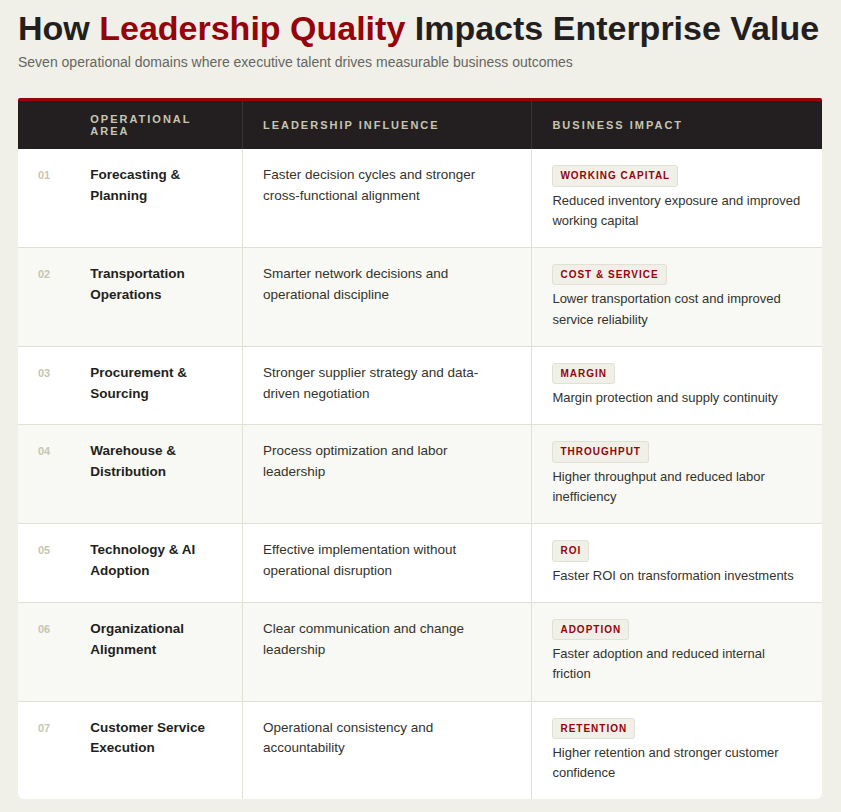
Leadership determines how quickly organizations adapt, how effectively teams execute, and whether transformation efforts create momentum or operational friction. That’s why leadership quality increasingly impacts enterprise value across transportation, logistics, and supply chain organizations — and why it’s more important than ever to pinpoint the right leadership talent to ensure your team stays ahead of the curve.

Scott is one of the founders of GESG and achieved great success as an executive recruiter. He is currently responsible for all internal operations and for relationships with all Partners and Suppliers. His first-hand recruiting experience gives him a customer-focused perspective, enabling him to maintain a razor-sharp focus on our technology and system priorities. Scott works closely with other firms in our network as well as suppliers to ensure that everyone in our firm has the current technology and market research resources necessary to meet the needs and requirements of our clients, top talent, and associates.